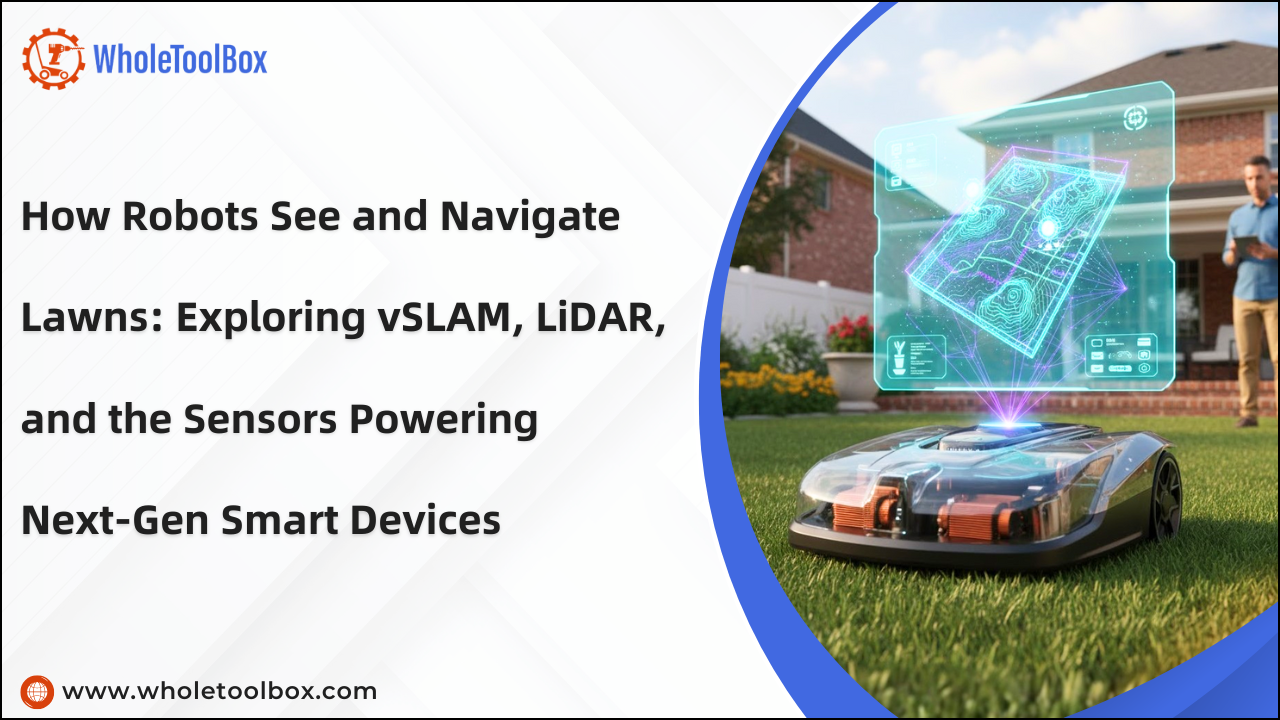
How Robots See and Navigate Lawns: Exploring vSLAM, LiDAR, and the Sensors Powering Next-Gen Smart Devices
Robots are rapidly changing how we interact with our homes, gardens, and lawns in America. Modern devices utilize cutting-edge technologies like vSLAM, LiDAR, and various advanced sensors to perceive their surroundings. These systems allow robots to create detailed maps, recognize obstacles, and navigate complex spaces with remarkable accuracy. From vacuuming floors to maintaining lawns and monitoring plant growth, robots are becoming indispensable tools that combine efficiency with intelligence.
The core of this transformation lies in how robots “see” and understand their environment. By processing data from sensors in real time, they can make decisions, plan routes, and perform tasks autonomously. As smart devices continue to evolve, understanding these technologies helps Americans appreciate the innovation behind next-generation robotics.
Understanding Robotic Navigation: From Mapping to Movement
While most discussions focus on robots avoiding obstacles, the real innovation lies in how they adapt, predict, and optimize movement in dynamic environments like homes, gardens, and lawns. Modern navigation isn’t just about moving from point A to B; it’s about learning and interacting with spaces intelligently.
-
Predictive Obstacle Modeling: Some robots anticipate where moving objects (pets, humans) will be in the next few seconds, not just avoid current positions.
-
Micro-Mapping for Efficiency: High-precision sensors allow robots to detect floor texture, carpet height, or garden soil density to adjust movement and task intensity.
-
Energy-Aware Navigation: Advanced devices plan routes that minimize battery usage, balancing efficiency with task completion.
-
Semantic Mapping: Robots don’t just map walls; they recognize furniture types, doorways, or plant locations, allowing smarter decision-making for specific tasks.
-
Adaptive Learning Loops: Each run improves performance; robots learn room patterns, peak activity hours, and even seasonal changes (like garden growth) to optimize navigation.
-
Collaborative Navigation: Some smart devices communicate with other robots or IoT devices to coordinate movement, avoiding congestion or redundancy.
By combining these capabilities, robots move beyond basic mapping—they understand, predict, and interact with spaces like never before.
vSLAM: How Robots Map and Understand Their Environment
vSLAM (Visual Simultaneous Localization and Mapping) allows robots to perceive, map, and navigate a variety of spaces intelligently. By creating dynamic visual maps, robots can operate autonomously in homes, small gardens, and larger outdoor areas.
-
Indoor & Small Garden Mapping: Robots scan compact indoor spaces and backyard or indoor gardens. They detect walls, furniture, carpets, planters, garden beds, and patio layouts, allowing smooth navigation in tight or confined areas.
-
Outdoor Mapping: Larger gardens, lawns, patios, and driveways are mapped for plants, trees, uneven terrain, pathways, and outdoor furniture. Robots can safely move in these open spaces while avoiding obstacles.
-
Dynamic Adaptation: vSLAM helps robots adjust to changes in the environment, such as moved furniture, pets, or seasonal plant growth.
-
Feature Detection & Semantic Understanding: Robots identify landmarks and zones, distinguishing planter areas or garden sections for optimized task execution.
-
Depth, Distance & Path Planning: Robots calculate distances to obstacles, steps, or soil variations and plan efficient routes for tasks such as watering, cleaning, and monitoring.
-
Learning & Map Refinement: Repeated use improves mapping accuracy and navigation strategies over time, enhancing autonomous operation.
By mapping both small indoor/backyard gardens, as well as larger outdoor areas, vSLAM enables robots to navigate intelligently and perform tasks efficiently in all environments.
How Robots Combine Sensors and Mapping to Navigate Efficiently
Next-generation lawn robots don’t just detect objects; they analyze patterns, predict changes, and coordinate multiple systems to optimize lawn care intelligently.
|
Integrated System |
Function in Lawn Navigation |
Advantage |
|
Predictive Path Mapping + Growth Analysis |
Uses historical lawn data to forecast optimal mowing paths based on growth patterns |
Reduces redundant passes and ensures even coverage |
|
Dynamic Slope Mapping + Traction Control |
Combines slope detection with wheel adjustment systems |
Prevents slippage on small inclines or uneven garden terrain |
|
Sensor Fusion for Shade & Sun Mapping |
Integrates sunlight sensors with environmental maps |
Adjusts mowing or watering intensity depending on shaded vs sunny lawn areas |
|
Obstacle Memory + Re-Routing Algorithms |
Learns positions of recurring obstacles (garden toys, tools, bird feeders) |
Avoids repeated collisions and improves long-term efficiency |
|
Microclimate Integration + Task Scheduling |
Combines temperature, humidity, and soil conditions with mapping |
Executes mowing or watering at optimal times to prevent plant stress |
|
Pattern Recognition + Resource Optimization |
Detects worn paths or overused areas using mapping and sensors |
Focuses maintenance on stressed regions, saving time and energy |
LiDAR Technology: Precision Navigation for Smart Devices
LiDAR (Light Detection and Ranging) uses laser pulses to sense surroundings, but its potential goes far beyond simple mapping. In smart devices, it enables precision, adaptability, and advanced task execution that often goes unnoticed.
-
Surface & Terrain Analysis: LiDAR detects subtle variations in floor texture, soil density, or slopes, helping devices adjust speed, cleaning intensity, or watering patterns.
-
Edge & Drop Detection: It identifies stairs, ledges, or planter edges, preventing falls or damage in both homes and small gardens.
-
3D Object Profiling: Unlike basic sensors, LiDAR can measure object dimensions and height, allowing robots to differentiate between plants, furniture, or decorations.
-
Indoor Light Independence: LiDAR operates reliably in low-light or variable lighting conditions, unlike camera-based systems, making it ideal for dimly lit indoor areas or shaded garden corners.
-
Multi-Robot Coordination: Advanced LiDAR-equipped devices can share spatial data with other robots, avoiding collisions and optimizing collaborative tasks.
-
Environmental Awareness Beyond Navigation: Some devices use LiDAR to monitor growth patterns, detect overgrown plants, or identify obstacles that need maintenance.
-
Long-Term Learning: By continuously analyzing the environment, LiDAR helps robots adapt over time to seasonal changes, rearrangements, or new objects.
LiDAR gives smart devices high-precision awareness, enabling them to navigate, adapt, and interact with complex spaces in ways traditional sensors cannot.
Advanced Sensors Powering Next-Generation Robotics
Modern lawn robots rely on an array of advanced sensors that go far beyond basic navigation. These sensors allow machines to understand grass, soil, obstacles, and environmental conditions, enabling highly efficient and adaptive lawn care.
-
Soil Moisture Sensors: Detect subtle changes in soil dampness to adjust watering patterns, prevent overwatering, and maintain healthy grass growth.
-
Grass Density and Health Sensors: Measure grass height, thickness, and even color to optimize mowing height and frequency, while identifying stressed areas.
-
Micro-Terrain Sensors: Detect small bumps, dips, or uneven soil patches, allowing robots to adjust wheel traction and avoid damaging the lawn.
-
Weather and Environmental Sensors: Track sunlight, temperature, and humidity to optimize operations and avoid mowing during wet or fragile conditions.
-
Boundary & GPS Sensors: Precisely define lawn edges, flower beds, and restricted areas, preventing robots from straying into garden paths or neighboring spaces.
-
Obstacle Recognition Sensors: Identify low-growing plants, garden ornaments, or fallen branches, enabling safe navigation without damaging delicate objects.
-
Adaptive Learning Sensors: Some devices record lawn changes over seasons like growth patterns, fallen leaves, or newly planted areas, allowing smarter, seasonal adjustments.
By combining these sensors, next-generation lawn robots don’t just navigate, they analyze, adapt, and care for lawns intelligently, offering a level of precision and customization rarely discussed in mainstream coverage.
Find out how to winterize lawn mowers: essential tips at the end of the season to protect your engine, prevent damage, and ensure your mower starts smoothly next spring.
Optimizing Lawn Care with Smart Robotics
Smart robotics optimizes lawn care by adapting to lawn size, shape, and physical properties. This allows robots to plan efficient movement, mowing patterns, and resource use.
|
Lawn Type |
Area |
Layouts |
Robot Implications |
|
Micro Lawns (Very Small) |
~5–50 m² |
Small courtyard lawns, balcony planters, tiny backyard patches |
Requires tight maneuvering, precise corner detection, and short mowing or watering cycles |
|
Small Lawns |
50–200 m² |
Standard backyard gardens, front yard lawns |
Moderate route planning, shorter battery/mowing cycles, may need obstacle memory for garden furniture or planters |
|
Medium Lawns |
200–500 m² |
Larger suburban lawns, parks adjacent to homes |
Needs efficient path planning, may divide lawn into micro-zones, optimize mowing and watering based on grass density |
|
Large Lawns |
500–1,000 m² |
Estates, golf course sections, and large garden lawns |
Requires advanced mapping (vSLAM/LiDAR), multi-pass mowing, recharge or battery management strategies |
|
Very Large Lawns |
1,000 m²+ |
Public parks, sports fields, and commercial landscapes |
Often managed with multiple robots, highly optimized scheduling, and GPS-guided precision |
By considering lawn size, layout, and function, smart robots adapt mowing, watering, and maintenance strategies for maximum efficiency, precision, and healthy lawn growth.
Explore the rise of robotic yard work: how AI is changing lawn care by automating mowing, trimming, and maintenance for faster, smarter, hands-free yard management.
Future-Ready Robotics: Optimizing Homes and Gardens with Precision and Intelligence
Future-ready robotics are transforming how we care for our homes and gardens. By combining advanced sensors, mapping technologies, and adaptive algorithms, smart devices deliver precision, efficiency, and consistent results. These innovations empower homeowners to save time, reduce waste, and maintain healthier, more vibrant spaces.
Key Takeaways:
-
Robots can autonomously detect micro-variations in soil firmness to adjust mowing or watering pressure.
-
Lawn robots now track growth velocity patterns to optimize mowing frequency dynamically.
-
Some devices can map seasonal sunlight and shade shifts to adapt maintenance routines.
-
Advanced sensors allow the detection of delicate plants or decorative elements to prevent damage.
-
Multi-robot systems can coordinate simultaneously for large lawns or complex garden layouts.
-
Real-time data analytics from sensors help predict maintenance needs before problems occur.
Smart robotics are redefining home and garden care by integrating intelligence, adaptability, and precision. These systems not only save effort but also enhance plant health and lawn aesthetics. The future of home automation is smarter, more efficient, and fully data-driven.
Looking for a way to fix your lawn or garden equipment quickly? WholeToolBox offers top-quality replacement parts such as lawn mower blades, drive belts, ignition coils, and more from leading brands like Honda, Husqvarna, and Toro. Get the right parts with fast shipping and smooth performance so your yard stays perfectly maintained year-round!
References:
https://spectrum.ieee.org/irobot-terra-robotic-lawnmower
https://www.frontiersin.org/journals/plant-science/articles/10.3389/fpls.2024.1377269/full
FAQs
How much does a high-end robot lawn mower cost, and what affects the price?
Advanced models range from $1,500 to over $6,000, depending on coverage area, sensor complexity, and integration with smart home or garden systems. Commercial-grade units can exceed $10,000 due to multi-robot coordination, GPS accuracy, and industrial durability.
Why does setting up a robot mower require careful lawn preparation?
Robots rely on precise mapping, boundary recognition, and sensor calibration, which can fail if uneven terrain or hidden obstacles exist. Proper setup also includes slope analysis and docking station placement to optimize battery usage and coverage efficiency.
Why is investing in commercial-grade robotic mowers considered cost-effective long-term?
High initial costs are offset by reduced manpower, fuel consumption, and predictable maintenance cycles. Automated mowing schedules allow multiple properties to be serviced efficiently, enhancing overall ROI for landscaping businesses.