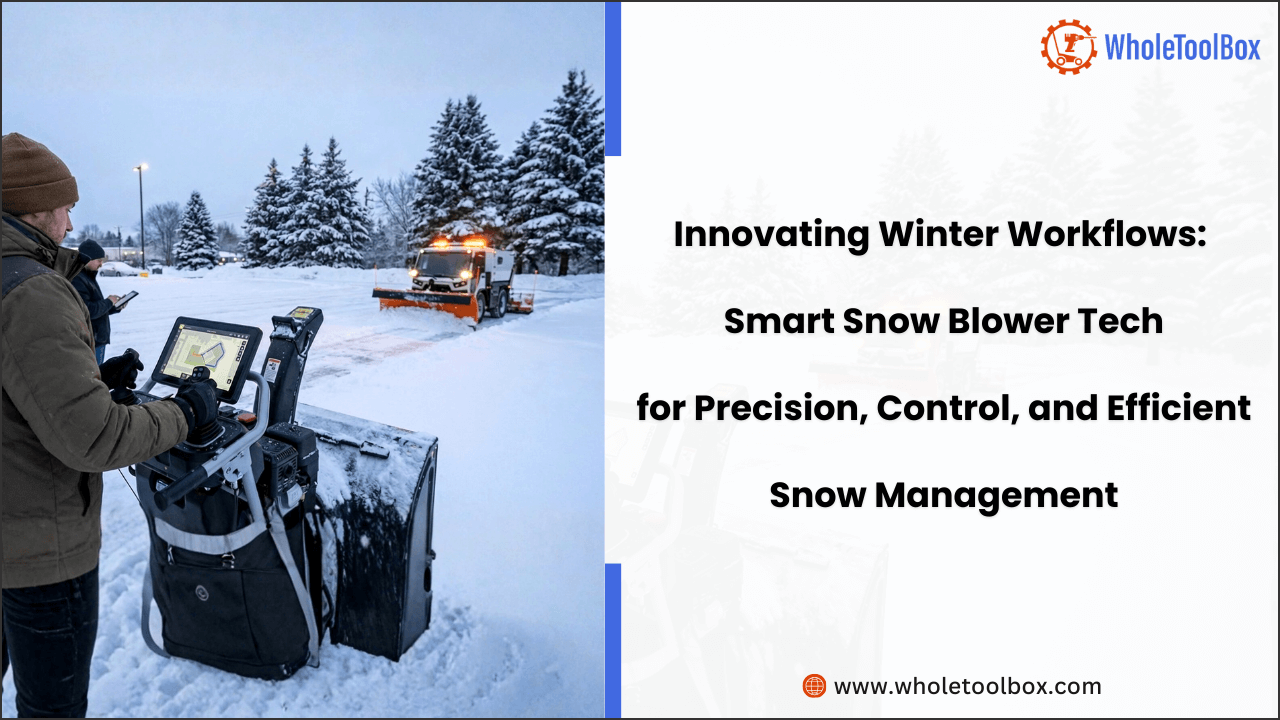
Innovating Winter Workflows: Smart Snow Blower Tech for Precision, Control, and Efficient Snow Management
Winter maintenance is a critical yet challenging aspect of property management, municipal services, and industrial operations. Snow removal, in particular, can consume substantial time, labor, and resources while posing safety risks to operators and the public. Over the past decade, technological advancements have transformed snow management, introducing smart snow blower systems that enhance efficiency, precision, and control. These innovations are redefining winter workflows, enabling professionals to manage snow more effectively while minimizing operational costs and hazards.
In this blog, we explore how smart snow blower technology is shaping modern winter workflows, the key features driving operational efficiency, and best practices for adopting these systems in commercial, municipal, and industrial contexts.
Why Smart Snow Blower Technology Matters
Traditional snow removal equipment often requires significant manual effort and frequent adjustments, reducing efficiency and increasing mechanical wear, especially on irregular terrain. Smart snow blower technology overcomes these limitations by integrating advanced sensors, automated controls, and data-driven systems that adapt to changing conditions. This enhances performance consistency and operational efficiency. Key benefits include faster snow removal with optimized fuel use, improved safety by reducing operator strain, precise handling in complex environments, and valuable insights for maintenance planning and workflow improvement.
Core Technologies Driving Smart Snow Blower Innovation
Several key technologies underpin modern smart snow blowers. Understanding these systems provides insight into their transformative impact on winter operations.
-
Ultrasonic and LiDAR Sensors: These detect obstacles, measure snow depth, and navigate terrain. LiDAR creates 3D maps, helping avoid collisions, find efficient paths, and adjust auger speed and chute direction in real time.
-
GPS and Geospatial Mapping: GPS guides machines along predefined routes, tracks cleared areas, and integrates with fleet management for coordinated operations.
-
Automation and Adaptive Controls: These systems adjust engine speed, auger rotation, and chute direction based on snow type and terrain, optimizing performance and energy use.
-
Real-Time Data Monitoring and Analytics: Telematics systems capture operational data such as engine performance, fuel consumption, auger efficiency, path coverage, and maintenance alerts.
Explore the future of snow removal: exploring advanced snow blower technology for smarter, faster, and safer winter operations.
Benefits and Real-World Applications of Smart Snow Blower Technology
Smart snow blowers offer faster, safer, and more efficient snow removal with lower costs and environmental impact. The table below outlines their key benefits and real-world applications.
|
Benefit |
Description |
Applications |
|
Increased Productivity |
Faster, more efficient snow removal with fewer passes, leveraging sensor-guided and automated operations. |
Municipal streets, commercial parking lots, and industrial yards |
|
Enhanced Safety |
Reduces operator fatigue and minimizes accident risk through obstacle detection and adaptive controls. |
Industrial facilities, sidewalks, residential estates |
|
Precision Performance |
Consistent clearing in complex or tight areas, enabled by LiDAR mapping and GPS navigation. |
Airports, office campuses, logistics hubs |
|
Cost Efficiency |
Predictive maintenance and data-driven monitoring lower downtime and fuel usage. |
Municipal fleets, commercial properties, and industrial sites |
|
Environmental Sustainability |
Optimized fuel consumption and reduced emissions through intelligent route planning and automation. |
Eco-conscious cities, warehouses, and shopping centers |
|
Data-Driven Insights |
Telematics track performance, routes, and maintenance needs, supporting workflow optimization. |
Large-scale snow management, private estates, and commercial complexes |
|
Versatility |
Adaptable to municipal, commercial, industrial, and residential applications. |
Street clearing, parking lots, loading areas, and private properties |
Best Practices for Adopting Smart Snow Blower Technology
To maximize the benefits of smart snow blower systems, organizations should consider several best practices.
Assess Operational Needs: Before investing in a smart snow blower, assess your operational needs, including area size, typical snow conditions, and how often snow removal is required. This helps determine the right machine specifications, sensors, and automation features.
Invest in Training: Invest in operator training to ensure effective use of smart snow blowers. Training should cover sensor calibration, route planning with GPS, and safety protocols. Well-trained operators can maximize the machine’s capabilities while maintaining safety and efficiency.
Implement Fleet Management Solutions: It is to optimize operations when using multiple snow blowers. Centralized platforms enable real-time tracking of machine locations, proactive maintenance scheduling, and efficient coordination across multiple sites.
Prioritize Maintenance and Calibration: Even with automation, smart snow blowers need regular maintenance to perform effectively. This includes inspecting augers, belts, and drive systems, cleaning sensors and LiDAR components, and monitoring engine health and fluid levels. Routine upkeep ensures consistent performance and prolongs the equipment’s lifespan.
Leverage Data Analytics: Operational data from smart snow blowers offers valuable insights for improving workflows. By analyzing metrics like average clearing times, path efficiency, fuel consumption, and sensor alerts, organizations can refine snow removal strategies and enhance long-term efficiency.
Check out last minute mistakes to avoid when using snow blowers this winter to ensure safe, efficient, and trouble-free snow removal.
Future Trends in Smart Snow Blower Technology
The future of winter workflow management will continue to be shaped by technological advancements. Emerging trends include:
Fully Autonomous Snow Blowers: Advances in autonomous vehicle technology are now applied to snow blowers. Fully autonomous models can operate without an operator, handle harsh winter conditions, and integrate with smart city systems, reshaping labor and operational planning in snow management.
AI and Machine Learning: AI-driven systems enhance snow blower performance by analyzing historical and real-time data. Machine learning can predict snow accumulation, suggest optimal clearing routes, and adjust machine settings dynamically, making operations more proactive and adaptive.
IoT Integration: Future snow blowers will use the Internet of Things (IoT) to connect with other devices and infrastructure. This enables coordinated clearing, real-time updates to traffic and weather systems, and remote diagnostics, making winter operations smarter and more efficient.
Conclusion: Transforming Winter Operations with Smart Snow Blowers
Smart snow blower technology is revolutionizing winter workflows by integrating automation, sensor-driven precision, and data analytics for faster, safer, and more efficient snow management. Across municipal, commercial, industrial, and residential sectors, these systems help optimize operations, cut labor and fuel costs, and enhance operator and public safety. Leveraging real-time insights and predictive maintenance ensures consistent performance even in challenging conditions, making winter operations more reliable and sustainable.
Key Takeaways
-
Smart snow blowers improve productivity and efficiency with automated, sensor-guided operations.
-
Safety is enhanced through obstacle detection, adaptive controls, and reduced operator fatigue.
-
Precision performance ensures consistent snow removal in complex terrains and environments.
-
Predictive maintenance and telematics reduce downtime and optimize operational costs.
-
Emerging trends like AI, IoT integration, and autonomous capabilities will further enhance winter workflows.
-
Adoption of these technologies supports sustainability and reduces fuel consumption and emissions.
As technology continues to advance, innovations such as fully autonomous snow blowers, AI-driven optimization, and IoT integration promise to further streamline workflows. Early adoption and strategic implementation of smart snow blowers enable organizations to stay ahead of operational challenges, maximize efficiency, and maintain high standards of winter safety and precision.
Upgrade and maintain your snowblower with essential parts from WholeToolBox, including quality idler pulleys, auger shafts, and electrical starters designed for brands like Ariens Company, Husqvarna, and MTD.
References:
https://www.consumerreports.org/home-garden/snow-blowers
https://ketteringhealth.org/using-your-snow-blower-safely
FAQs
What impact does GPS geofencing have on large-scale snow removal?
GPS geofencing ensures machines operate within designated zones, optimizing route coverage, preventing off-limit access, and enabling efficient management of municipal or corporate properties.
Can smart snow blowers communicate with multiple units for coordinated operations?
Yes, IoT-enabled snow blowers can share real-time location and status data, allowing multiple machines to coordinate routes and prevent redundant passes in large commercial or municipal areas.
What is the lifespan of a snow blower?
A snow blower’s lifespan depends on its type, usage, and maintenance. Single-stage models usually last 8 to 10 years, while two- or three-stage and smart snow blowers can last 15 to 20 years with proper care.