Lawn Care Industry Trends and Market Growth Outlook for 2026–2034
The U.S. lawn care industry is on a clear growth trajectory, with the market projected to rise from $62.91 billion in 2026 to nearly $92.9 billion by 2034, supported by steady housing expansion, rising suburban development, and increasing demand for outdoor living spaces. Lawn care is no longer limited to basic upkeep — it has become an important contributor to property value and curb appeal.
At the same time, the industry is becoming more technology-driven as businesses adopt automation and digital tools to improve efficiency and service quality. As customer expectations shift toward convenience and consistency, subscription-based and scalable service models are becoming the norm across residential and commercial segments.
This blog explores the key trends, growth drivers, challenges, and investment opportunities shaping the U.S. lawn care industry.
Emerging Trends Transforming the U.S. Lawn Care Market
Below are the major trends transforming the U.S. lawn care market and influencing future industry growth.
-
Smart equipment adoption is rising, including GPS-guided mowers, robotic mowers, drones, and battery-powered tools that improve efficiency and reduce labor dependency.
-
Subscription-based maintenance models dominate service structures, accounting for more than 60% of the market share due to demand for convenience and recurring services.
-
Sustainability trends are accelerating, with strong demand for pet-safe, eco-friendly landscaping options across residential and commercial segments.
-
Outdoor living upgrades like patios, gardens, lighting, and curb appeal improvements remain strong, with 92% of Realtors recommending lawn upgrades before property sales.
-
Large landscaping companies and franchise operators are reporting approximately 8–9% annual sales expansion, supported by digitalization, AI-driven route optimization, and data-driven service management systems.
Check out Smart lawn care evolution with intelligent robot mower technology, boosting efficiency through automation
Key Market Drivers Fueling Industry Growth in the U.S.
Housing expansion remains a core driver of market momentum in the U.S. lawn care industry, with ~145.3 million housing units in 2023 creating steady long-term demand for maintenance services. Suburban living trends and rising interest in outdoor aesthetics are further increasing investment in landscaped and functional yard spaces.
Rising disposable incomes are also accelerating the shift from DIY maintenance to professional lawn care services, particularly in suburban and higher-income residential segments. This reflects a broader preference for convenience and time-saving property upkeep.
Commercial and institutional clients add strong stability, contributing over half of total industry revenue (~54%) across offices, hotels, and government properties. Sector performance remains solid, with typical sales growth around 8.5% and average profit margins near ~13% in 2025, supported by digital platforms, AI-driven scheduling, and bundled service models.
Major Challenges Facing Lawn Care Businesses Today
The following are the major challenges affecting lawn care businesses today, amid rising operational and economic pressures.
-
Labor shortages remain the most critical challenge, with 67% of landscape businesses citing difficulty in finding qualified workers, leading to higher wages and delayed project execution.
-
Input costs have increased by approximately 20% since 2023, including fuel, fertilizers, and equipment expenses.
-
Environmental regulations are expanding, including fertilizer restrictions and water-use limitations, requiring investment in compliant practices and equipment upgrades.
-
Water scarcity and drought-related restrictions are reshaping traditional lawn maintenance approaches, increasing demand for drought-resistant solutions.
-
Weather volatility, including droughts, heavy rains, and wildfires, is disrupting seasonal planning and reducing operational predictability.
-
Market fragmentation limits smaller firms from achieving scale advantages, restricting reinvestment in technology and workforce development.
Investment Opportunities in the U.S. Lawn Care Sector
Below are the key investment areas expected to drive sustained long-term industry development and industry expansion across the sector.
-
Automation technologies such as robotic mowers, autonomous sprayers, IoT-based soil sensors, and route optimization platforms continue attracting investment.
-
The green product segment is expanding, encompassing organic fertilizers, drought-resistant seeds, and native landscaping solutions that align with the demand for sustainability.
-
Industry fragmentation is enabling consolidation strategies through regional acquisitions and roll-ups that create scalable service networks.
-
Franchise and branded service models remain attractive due to strong customer retention and profit margins of ~13% in many local markets.
-
Smart irrigation systems, outdoor lighting, and landscape enhancement services continue creating cross-selling and bundled revenue opportunities.
-
While ~64% of consumers prefer professional services, a ~36% DIY segment still creates opportunities for hybrid product-service business models.
Explore the Future of lawn care: Integrating RTK cloud and vision AI for unmatched mowing accuracy, redefining autonomous lawn care
Summary: Future Growth Outlook of the Lawn Care Industry (2026–2034)
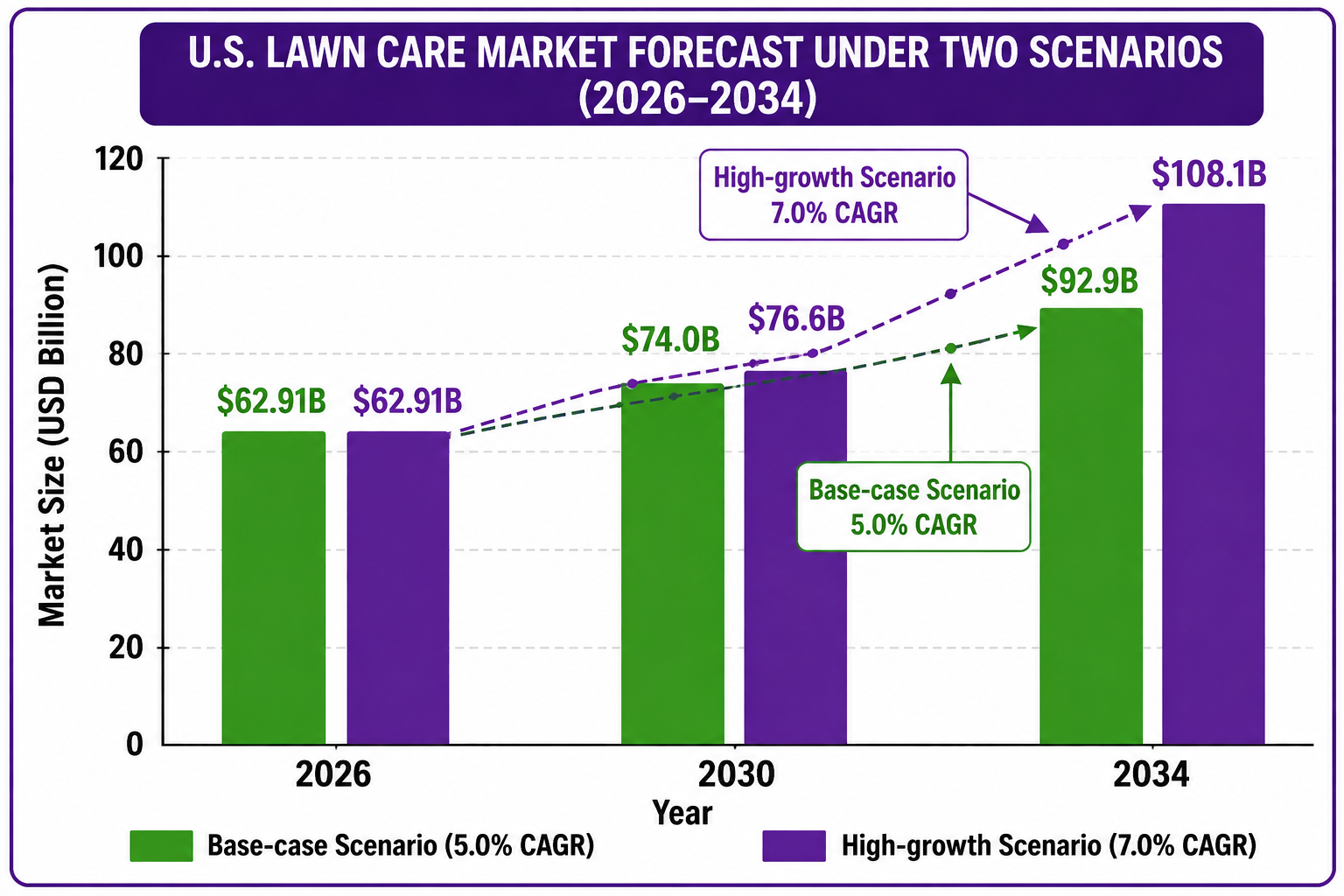
The U.S. lawn care market is projected to grow steadily from $62.91 billion in 2026 to approximately $92.9 billion by 2034 under a base-case scenario (~5.0% CAGR). Under a high-growth scenario (~7.0% CAGR), the market could reach nearly $108.1 billion by 2034.
The chart below represents the projected U.S. lawn care market expansion from 2026 to 2034.
Key Takeaways
-
Automation and AI tools like robotic mowers, IoT, and GPS systems are reshaping operations and improving efficiency.
-
Subscription-based and bundled services dominate due to their convenience and recurring revenue.
-
Growth is supported by housing expansion, suburban development, and strong commercial demand.
-
Industry remains profitable despite rising costs and labor shortages.
-
Key risks include ~20% input cost inflation, regulatory pressure, and weather volatility impacting operations.
Shop high-quality lawn & garden equipment parts at WholeToolBox. Find durable air filters, carburetors, crankshafts, flywheels, and fuel tanks from trusted brands like Makita, Honda, Echo, and Shindaiwa, designed to keep your lawn equipment running efficiently.
References:
https://www.mordorintelligence.com/industry-reports/united-states-lawn-care-market
https://news.growcycle.com/lawn-care-and-landscaping-industry-statistics-for-2025/
https://www.imarcgroup.com/united-states-lawn-care-market
https://www.landscapeprofessionals.org/LP/LP/Media/landscape-industry-statistics.aspx
FAQs
Which regions in the U.S. are driving lawn care market growth?
Growth is strongest in Sun Belt states like Texas, Florida, Arizona, and North Carolina due to warm climates, housing expansion, and higher landscaping demand.
What are standard profit margins in the lawn care industry?
Typical profit margins range from 5%–15%. Efficient businesses with strong contracts and route optimization can exceed 15%.
|
Disclaimer: This article is for informational purposes only. Market data, estimates, and forecasts are subject to change over time. |