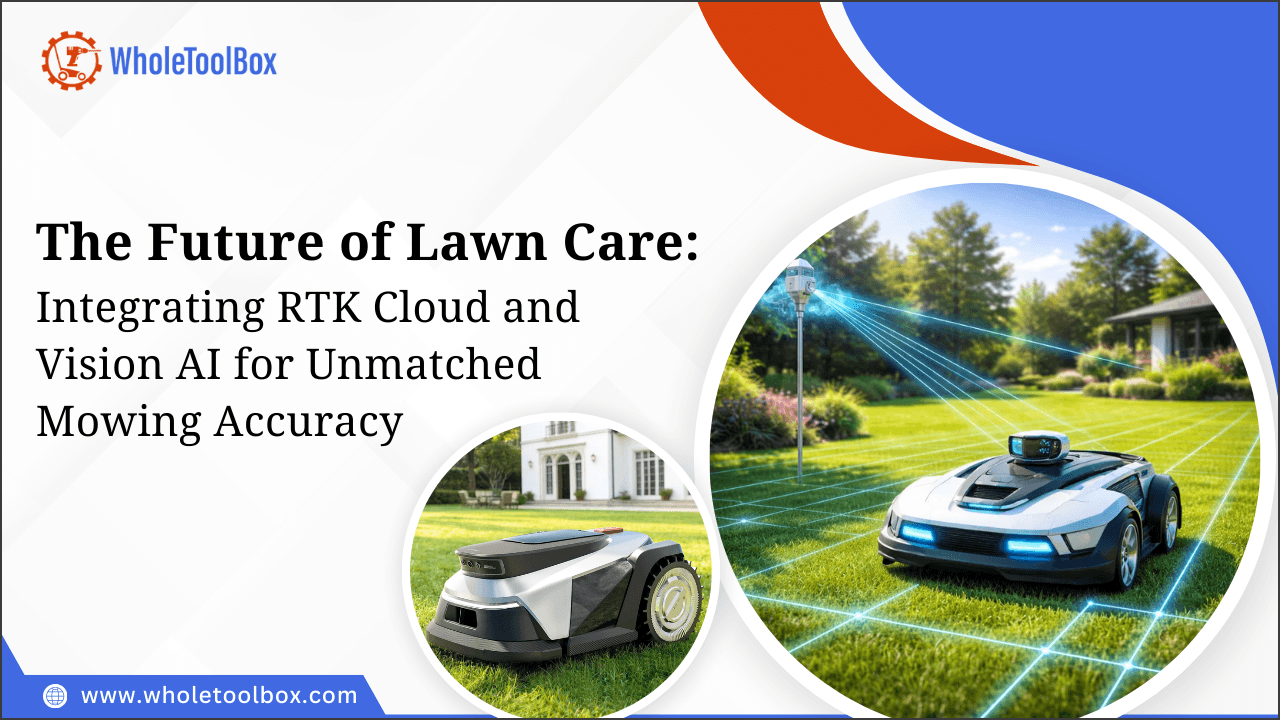
The Future of Lawn Care: Integrating RTK Cloud and Vision AI for Unmatched Mowing Accuracy
Imagine a lawn that is always perfectly manicured, with straight stripes, sharp edges, and no missed patches. Modern robotic mowers powered by RTK Cloud positioning and Vision AI achieve this by combining centimeter-level GPS accuracy with intelligent environmental perception.
These smart machines navigate complex landscapes, avoid obstacles, and optimize every pass for peak efficiency. In this article, we explore how these advanced technologies are transforming lawn care, enhancing precision, saving time, improving safety, and promoting sustainable practices for homeowners and professional landscapers alike.
What is RTK Cloud Technology and Its Role in Lawn Care
Real-Time Kinematic (RTK) technology enhances GPS positioning, achieving centimeter-level accuracy for robotic mowers. RTK Cloud delivers corrections via the internet or cellular networks (4G/5G), removing the need for a physical base station.
Services like Rock RTK Network, Hexagon SmartNet, and Leica SmartNet ensure mowers maintain precise location data in real time, even across large lawns. Key advantages of RTK cloud in lawn care are,
-
Precision Mowing: Mowers follow predetermined paths with minimal overlap or gaps.
-
Reliable Boundaries: Accurate geofencing keeps mowers within property lines, avoiding flowerbeds, driveways, and other obstacles.
-
Real-Time Updates: Instant corrections ensure consistent performance, even in dynamic environments.
While RTK Cloud services may involve subscription costs (ranging from $40/month to $2,400/year, depending on coverage), they eliminate the need for expensive hardware and provide flexible scalability for residential and commercial users.
Understanding Vision AI in Modern Robotic Lawn Mowers
Vision AI enables robotic mowers to perceive and interpret their surroundings using cameras, LiDAR, and sometimes radar or ultrasonic sensors. Machine learning algorithms process this visual data, allowing the mower to navigate complex environments intelligently. Below are the applications of vision AI in lawn mowers,
-
Obstacle Detection: Cameras and LiDAR identify objects like pets, toys, or garden furniture to ensure safe navigation.
-
Terrain Recognition: AI differentiates grass from pavements, flowerbeds, and soil patches to maintain proper mowing boundaries.
-
Adaptive Path Planning: By analyzing the environment, Vision AI optimizes mowing routes for maximum efficiency.
-
Real-Time Decision Making: Edge AI chips process visual information locally, enabling immediate responses to unexpected obstacles or terrain changes.
Advanced mowers also use SLAM (Simultaneous Localization and Mapping) combined with Vision AI to map lawns accurately, ensuring the mower can return to precise locations even after interruptions.
Find out how robots see and navigate lawns: exploring vSLAM, LiDAR, and the sensors powering Next-Gen smart devices, and how these technologies enable precise and intelligent robotic mowing
How RTK Cloud and Vision AI Work Together for Precision Mowing
While RTK Cloud provides precise global positioning, Vision AI offers local environmental awareness. Together, these technologies create a multi-sensor fusion system that ensures efficient, safe, and highly accurate mowing. Key integration features are,
-
Global Positioning + Local Perception: RTK determines the mower’s exact location, while Vision AI identifies obstacles and edges for adaptive navigation.
-
Real-Time Path Adjustments: Vision AI continuously monitors the lawn and dynamically adjusts routes, while RTK ensures that the mower remains aligned with pre-programmed geofenced paths.
-
Obstacle Handling: AI vision detects moving objects like pets or children, while RTK ensures that deviations from the path remain within acceptable margins.
-
Mapping & Resumption: RTK fixes provide global reference points, enabling the mower to resume tasks accurately after charging or interruptions.
Advantages of Using Smart Technology in Lawn Care
Below are the advantages of integrating RTK and Vision AI into modern robotic mowers:
-
Unmatched Mowing Precision: With centimeter-level GPS accuracy and AI-driven navigation, mowers maintain consistent stripes, perfectly trimmed edges, and complete lawn coverage without gaps or redundancy.
-
Time and Labor Savings: Robotic mowers automate regular mowing, freeing up homeowners’ time and reducing the need for manual supervision. Adaptive AI reduces mowing time by optimizing routes and minimizing overlap.
-
Enhanced Safety: Vision AI systems detect obstacles in real-time, avoiding collisions with pets, children, or objects. Combined with safety features like lift and tilt sensors, these mowers reduce accidents compared to traditional robotic systems.
-
Cost Efficiency: While the initial investment is higher, robotic mowers reduce labor costs, fuel use, and equipment wear over time.
-
Environmental Benefits: Electric robotic mowers run quietly, reduce emissions, and can mulch grass clippings back into the soil, promoting healthier turf and reducing chemical fertilizer needs. Optimized mowing frequency ensures better grass health and lower environmental impact.
-
Smart Lawn Management: Connected apps allow remote monitoring, schedule adjustments, and setting virtual boundaries. Advanced analytics provide insights on mowing patterns, growth trends, and energy usage, making lawn care more efficient and data-driven.
Summary: The Future of Smart and Precise Lawn Care
Smart lawn care is evolving with RTK Cloud positioning and Vision AI, delivering unmatched mowing precision and efficiency. Robotic mowers navigate complex landscapes, avoid obstacles, and maintain perfect stripes and edges. These technologies save time, reduce labor, enhance safety, and support sustainable practices.
Key Takeaways:
-
RTK Cloud provides centimeter-level GPS accuracy for precise mowing paths.
-
Vision AI enables obstacle detection, terrain recognition, and adaptive navigation.
-
Multi-sensor fusion ensures efficient, safe, and uninterrupted mowing.
-
Smart mowers reduce labor, save time, and lower operational costs.
-
Electric robotic mowers promote environmental sustainability and reduce emissions.
-
Connected apps allow remote monitoring, virtual boundaries, and data-driven lawn management.
Shop high-quality lawn equipment parts at WholeToolBox. We offer durable engine gaskets, ignition coils, motors, mufflers, and oil filters and seals from trusted brands like Honda, Husqvarna, Toro, Homelite & more, built for long-lasting durability.
References:
https://www.asme.org/topics-resources/content/robots-cut-grass-with-class
https://www.opei.org/news-updates/robotic-lawn-mowers-first-ansiopei-standard-officially-publishes-on-friday-january-31/
FAQs
Can robotic lawn mowers handle uneven terrain?
Yes, most robotic mowers can manage slopes up to 25 to 35% (around 14 to 19°). For very steep or rocky areas, models with larger wheels and advanced sensors are recommended.
How long does a robotic lawn mower last?
With proper care, a robotic lawn mower can last 7 to 10 years. Its lifespan depends on factors like usage, terrain, and maintenance. Batteries typically need replacement every 3 to 5 years, and regular cleaning and blade upkeep help extend overall durability.
| Disclaimer: This article is for informational purposes only. Lawn care technologies, including RTK Cloud and Vision AI mowers, may vary by model and region. Always follow manufacturer guidelines and safety instructions, as we are not liable for any damage, injury, or loss from using these technologies. |