Wire-Free Robotic Lawn Mowers: How AI and GPS Are Transforming Lawn Care
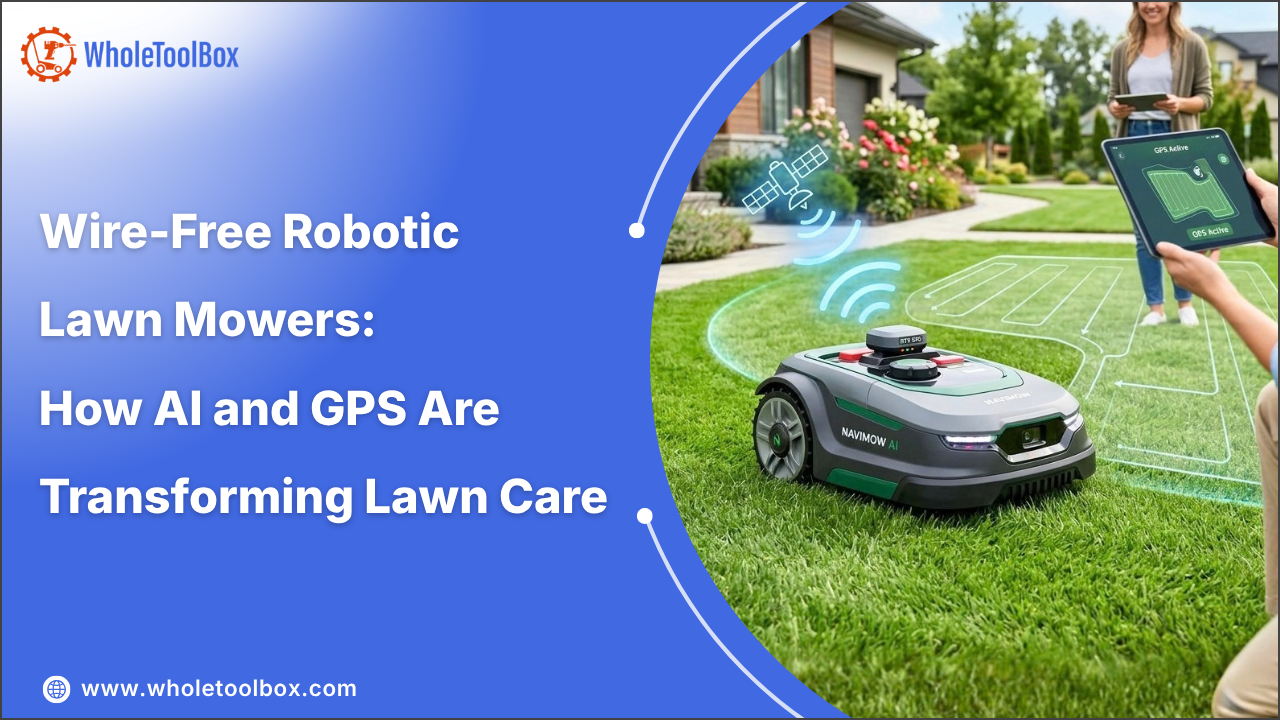
Wire-free robotic lawn mowers automate lawn maintenance by using positioning systems, sensors, and digital mapping to mow grass without physical boundary wires. These autonomous machines follow programmed routes and operate within digitally defined mowing areas, reducing the need for manual lawn care.
Technologies such as Real-Time Kinematic (RTK) GPS, artificial intelligence (AI), and computer vision help compatible mowers navigate their surroundings. Depending on the model, these systems support precise positioning, obstacle detection, and automated route planning.
This blog explains how wire-free robotic lawn mowers operate, examines the technologies behind their navigation, and compares them with boundary-wire alternatives. It also covers common operating challenges and the specifications to evaluate when choosing a mower for your property.
|
Table of Contents: |
How Wire-Free Robotic Mowers Navigate Without Boundary Wires
Wire-free robotic lawn mowers operate within a virtual mowing area rather than relying on a physical perimeter wire. Their navigation software uses location data and onboard sensors to carry out the configured mowing plan. The basic operating process involves the following steps:
- Map the Lawn: The user creates a digital layout of the mowing area using the manufacturer's app or supported mapping system.
- Configure the Mowing Area: The user establishes the lawn perimeter, identifies restricted areas, and defines routes between separate grass sections where supported.
- Set the Mowing Schedule: The user selects operating times and other available mowing settings.
- Execute the Mowing Plan: The mower follows its programmed route and uses its available navigation systems to remain within the configured area.
- Return for Charging: When required, the mower returns to its charging station according to its supported operating logic.
The amount of manual setup depends on the model. Some mowers require users to guide the machine around the lawn during initial mapping, while others support automated mapping methods.
Find out how robots see and navigate lawns: exploring vSLAM, LiDAR, and the sensors powering Next-Gen smart devices, and how these technologies enable precise and intelligent robotic mowing
Technologies That Enable Wire-Free Mowing
Wire-free robotic lawn mowers combine satellite positioning, AI-powered vision, and digital mapping to navigate lawns without physical boundary wires. Each technology supports a different function, from maintaining accurate mowing routes to detecting obstacles and managing multiple lawn areas. Features and performance vary by manufacturer and model.
RTK GPS Positioning
Real-Time Kinematic (RTK) positioning uses satellite signals and correction data to improve a mower’s location accuracy. For example, Husqvarna states that its EPOS-supported robotic mowers can achieve positioning accuracy better than 2 cm when using a local reference station, depending on the installation method. This precision helps compatible mowers follow virtual boundaries and planned mowing paths, although buildings, trees, and other obstructions can affect satellite reception.
Key Features and Benefits
- Centimetre-Level Accuracy: Helps the mower follow planned routes with fewer missed or overlapping strips.
- Virtual Boundaries: Defines mowing areas digitally, eliminating the need for a buried perimeter wire.
- Consistent Route Planning: Supports systematic mowing patterns instead of relying solely on random movement.
- Signal Limitations: Dense tree cover and obstructed satellite reception can reduce accuracy or interrupt navigation.
AI and Computer Vision
AI and computer vision use cameras and image-processing software to interpret visual information from the mower's surroundings. Depending on the model, these systems can recognize obstacles, distinguish grass from certain surrounding surfaces, and adjust movement based on detected objects.
Key Features and Benefits
- Object Recognition: Helps identify objects such as toys and garden furniture in the mower's path.
- Visual Route Adjustments: Allows the mower to respond to detected objects or changes in its surroundings.
- Grass Recognition: Helps compatible systems distinguish grass from some non-grass surfaces.
- Additional Navigation Support: Camera-based systems may supplement other navigation technologies when conditions permit, depending on the model.
Digital Lawn Mapping
Digital lawn mapping lets homeowners create a virtual layout of their property through a smartphone app or a supported mapping system. Users can establish mowing boundaries, divide the lawn into zones, mark restricted areas, and create paths between separate sections. For example, selected MOVA LiDAX Ultra models support up to 150 zones, paths, and no-go zones per map, with dual-map functionality on supported models, illustrating how mapping capabilities vary by product.
Key Features and Benefits
- Custom Mowing Zones: Divides the property into separate areas that can be managed individually.
- Virtual No-Go Areas: Identifies spaces where mowing should be restricted, such as flower beds or ponds.
- Editable Lawn Layouts: Allows users to update digital boundaries when landscaping changes.
- Zone-Specific Scheduling: Enables different mowing schedules or settings for individual areas on compatible models.
Note: Specifications vary by manufacturer and model. Consult product documentation for positioning accuracy, supported mapping capacity, and operating requirements.
Check out smart lawn care evolution with intelligent robot mower technology to discover the future of automated mowing
Wire-Free vs. Boundary-Wire Robotic Mowers
Both wire-free and boundary-wire robotic mowers automate routine lawn maintenance, but they differ in installation, navigation, and boundary adjustments. The following six features highlight their main differences.
|
Feature |
Wire-Free Robotic Mowers |
Boundary-Wire Robotic Mowers |
|
Boundary Setup |
Creates virtual boundaries using digital mapping |
Uses a physical perimeter wire |
|
Installation |
Requires map configuration and positioning setup |
Requires physical wire installation and connection |
|
Boundary Adjustments |
Virtual boundaries can usually be edited through an app |
Changes may require repositioning the wire |
|
Navigation Technology |
Uses RTK-GPS, cameras, sensors, or combined systems, depending on the model |
Uses the boundary wire to define the mowing area, supported by onboard navigation systems |
|
Positioning Accuracy |
Some RTK systems offer approximately 2 cm accuracy under suitable conditions |
Boundary guidance follows the installed wire; RTK accuracy is generally not required |
|
Common Issues |
Satellite signal loss, mapping errors, or sensor problems |
Wire breaks, loose connections, or installation damage |
Limitations and Challenges of Wire-Free Mowing
Although wire-free robotic mowers reduce installation work in many situations, their performance depends on the lawn's physical layout and the technology used.
- Satellite Signal Interruptions: Trees, tall buildings, and covered passages can obstruct satellite reception. This may disrupt positioning or require the mower to use alternative navigation methods, where available.
- Complex Lawn Layouts: Narrow corridors, disconnected grass sections, steep slopes, and irregular terrain may restrict movement. Some properties require additional connecting paths or separate mowing areas.
- Higher Purchase Costs: Models with advanced positioning systems, cameras, and mapping features may cost more than basic boundary-wire alternatives. Battery replacement, blade purchases, accessories, and servicing also contribute to ownership costs.
- Mapping and Setup Errors: Incorrect virtual boundaries can result in missed areas or movement into restricted spaces. Errors may require remapping or adjustments to the configured layout.
- Weather and Visibility Limitations: Wet grass can reduce traction, while mud can affect movement. Poor visibility may also affect camera-based detection, depending on the system. Weather-resistant construction does not guarantee suitability for every operating condition.
- Connectivity and Software Dependence: Some features rely on wireless connectivity, satellite correction services, smartphone apps, or manufacturer software. Available functions may differ when connectivity is interrupted.
- Residual Safety Risks: Obstacle-detection systems can miss small objects, wildlife, or other hazards. Users must follow manufacturer safety instructions and keep children and pets away from operating equipment.
Key Factors to Consider When Choosing a Wire-Free Robotic Mower
Compare these factors to find a wire-free robotic mower that fits your lawn size, terrain, and maintenance needs.
- Lawn Size and Mowing Capacity: Check the recommended lawn area and daily mowing capacity. For example, the Segway Navimow X330 is rated for lawns up to 1 acre, while the X350 is rated for up to 1.5 acres. Choose a model that can cover your entire lawn, including separate sections.
- Navigation Technology: Compare RTK-GPS, AI vision, and sensor-based navigation. Check positioning accuracy and whether the mower requires a reference station, cellular connection, or subscription.
- Terrain and Slope Capability: Check the maximum slope rating, wheel traction, and drive system. The Husqvarna Automower 435X AWD can handle slopes up to 70% within its mowing area and 50% at the boundary. Wet grass and uneven ground can affect traction.
- Obstacle Detection and Security: Review the available lift and tilt sensors, obstacle-detection functions, PIN protection, and anti-theft features. Check how the mower responds to detected objects and what additional supervision the manufacturer recommends.
- Battery Life and Charging: Compare mowing runtime, charging duration, and coverage per charge. Consider how often the mower must recharge to maintain your lawn within the available operating schedule.
- Cutting Performance and Blade Replacement: Check cutting width, adjustable cutting height, blade type, and replacement costs. Confirm that compatible blades are available and that routine replacement is practical for your maintenance schedule.
- App Controls and Zone Management: Evaluate scheduling options, remote controls, and the number of mowing zones supported. Confirm that the mower can manage your property's separate grass sections and any required connecting paths.
- Weather Resistance and Maintenance: Check the enclosure's IP rating, permitted operating conditions, cleaning instructions, and winter-storage requirements. Review the manufacturer's maintenance schedule before making a purchase.
Summary: The Future of Wire-Free Robotic Lawn Mowing
Wire-free robotic lawn mowers use RTK-GPS, AI-powered vision, and digital mapping to automate lawn care without physical boundary wires. These technologies simplify navigation, support customized mowing zones, and improve obstacle detection. However, performance depends on satellite reception, terrain, lawn layout, and model-specific capabilities.
Key Takeaways
- RTK-GPS positioning enables precise navigation and virtual boundaries under suitable conditions.
- AI and computer vision help detect obstacles and adjust mowing routes.
- Digital lawn mapping allows users to define mowing zones and restricted areas through an app.
- Wire-free models simplify boundary adjustments, while boundary-wire models rely on physical perimeter wires.
- Satellite interference, complex terrain, and connectivity issues can affect mowing performance.
- Compare lawn capacity, slope capability, battery runtime, safety features, and maintenance costs before choosing a mower.
Shop high-quality lawn & garden equipment parts at WholeToolBox. Find durable air filters, carburetors, crankshafts, flywheels, and fuel tanks designed to keep your lawn equipment running efficiently.
References:
https://navimow.com/pages/navimow-x3-specs
https://www.husqvarna.com/us/robotic-lawn-mowers/automower-435x-awd/
FAQs
Can robotic lawn mowers work in rainy or wet conditions?
Some robotic mowers can operate in light rain, but wet grass may reduce traction and cutting quality. Check the manufacturer’s rain sensor settings and weather recommendations before mowing in wet conditions.
What routine maintenance does a robotic lawn mower require?
Routine maintenance includes cleaning grass clippings from the deck and wheels, inspecting blades, checking sensors, and keeping charging contacts clean. Follow the manufacturer’s maintenance schedule.
How often do robotic mower blades need to be replaced?
Robotic mower blades typically need replacement every 1–3 months, depending on usage, lawn size, and blade condition. Replace dull or damaged blades according to the manufacturer’s instructions.
How long does a robotic mower take to recharge?
Most robotic mowers take approximately 30–120 minutes to recharge, depending on battery capacity and model. Check the manufacturer’s specifications for the exact charging time.
Can robotic lawn mowers operate safely around pets?
Robotic mowers include safety features such as lift sensors and obstacle detection, but these do not eliminate all risks. Keep pets supervised and follow the manufacturer’s safety guidance, especially during mowing.
|
Disclaimer: This content is for informational purposes only. Always follow the manufacturer’s instructions for safe operation and maintenance. |