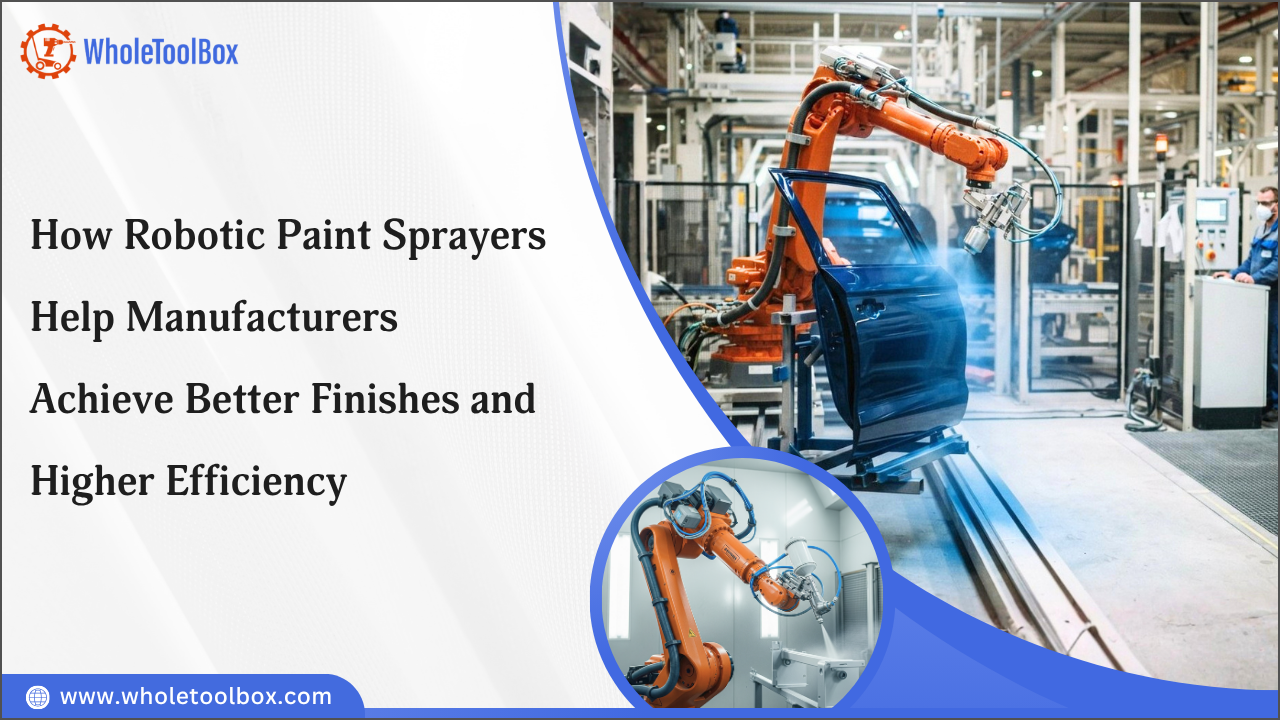
How Robotic Paint Sprayers Help Manufacturers Achieve Better Finishes and Higher Efficiency
Looking for a way to achieve faster production and more consistent paint finishes? Manufacturers are increasingly turning to robotic paint sprayers to overcome the limitations of manual coating processes and improve overall efficiency.
These automated systems provide precise spray control, reduce paint waste, and deliver uniform finishes across high-volume production lines. By combining advanced automation with reliable performance, robotic paint sprayers help businesses improve quality, safety, and long-term operational efficiency.
In this blog, we will explore why manufacturers are switching to robotic paint sprayers, how they improve finish quality, where they are used, and the key factors to consider when selecting the right system.
|
Table of Contents: |
Why Manufacturers Are Switching to Robotic Paint Sprayers
Below are the key advantages driving the shift toward automated painting solutions.
- Higher Productivity: Robotic paint sprayers operate continuously with consistent speed and precision, increasing production output while reducing cycle times and downtime.
- Lower Paint Waste: Automated spray systems apply coatings accurately, reducing overspray, paint consumption, solvent use, and cleanup costs while improving transfer efficiency.
- Better Finish Quality: Robots maintain consistent spray patterns, gun distance, and coating thickness, producing smooth, uniform finishes with fewer defects and less rework.
- Improved Workplace Safety: By automating painting inside enclosed spray booths, manufacturers reduce worker exposure to hazardous fumes, chemicals, and repetitive tasks.
- Long-Term Value: Robotic paint sprayers lower operating costs, improve production consistency, and support scalable, high-volume manufacturing, making them a smart long-term investment.
Check out the 2026 top 5 airless paint sprayers: ranked by speed, efficiency & real results for better painting performance
How Robotic Paint Sprayers Improve Finish Quality and Consistency
Robotic paint sprayers improve finish quality by maintaining precise control over spray distance, speed, angle, and coating thickness. Every part follows the same programmed spray path, producing smooth, even finishes with fewer defects such as streaks, runs, thin spots, and uneven coverage.
Advanced technologies like electrostatic and HVLP spraying further improve paint transfer efficiency while reducing overspray. Many robotic paint systems also use sensors and automated controls to monitor the coating process in real time.
When adjustments are needed, the system automatically fine-tunes spray settings to maintain consistent results. This level of accuracy reduces rework, minimizes material waste, and helps manufacturers achieve uniform finish quality across every production batch.
Check out paint sprayer troubleshooting 101: fix clogs, spitting, and uneven spray quick fixes for consistent results
Common Industrial Applications of Robotic Paint Sprayers
Below are the most common industrial applications of robotic paint sprayers across different sectors.
- Automotive and Electric Vehicles: Paint car bodies, bumpers, doors, wheels, and EV components with consistent finishes and minimal overspray. Multi-axis robots and electrostatic spray systems improve coating efficiency.
- Aerospace and Defense: Apply primers and protective coatings to aircraft fuselages, wings, and defense components while meeting strict quality and safety requirements in enclosed paint booths.
- Appliances and Consumer Goods: Coat refrigerators, washing machines, ovens, metal furniture, and consumer products with uniform finishes for high-volume manufacturing.
- Wood and Furniture Manufacturing: Apply stains, primers, lacquers, and clear coats to cabinets, doors, and furniture with consistent coverage and reduced material waste.
- Heavy Equipment and Metal Fabrication: Coat construction machinery, agricultural equipment, pipelines, and steel structures using corrosion-resistant industrial coatings for long-term durability.
- Specialty Manufacturing: Used in electronics, marine, medical device, and industrial equipment production, where accurate coating thickness and repeatable application are critical for product performance and compliance.
Factors to Consider When Choosing a Robotic Paint Sprayer
The following considerations will help you select the most suitable robotic paint sprayer.
- Payload & Reach: Choose a robot with enough payload capacity to support the spray gun, hoses, and accessories while providing sufficient reach to cover the entire workpiece. Large parts may require rail-mounted or multi-robot systems.
- Precision & Repeatability: High repeatability (typically ±0.1 mm or better) ensures accurate spray paths, uniform coating thickness, and consistent finish quality across every production cycle.
- Safety & Compliance: For flammable coatings, select paint-rated robots with IP-rated sealed joints, ATEX or FM-certified explosion-proof designs, and internal cable routing. Ensure the paint cell complies with NFPA 33, NFPA 70, and OSHA 29 CFR 1910.107 standards.
- Spray Technology: Verify compatibility with your coating process, including electrostatic, HVLP, air-assisted, airless, or rotary bell applicators, as well as waterborne, solvent-based, powder, or two-component coatings.
- Software & Automation: Look for features such as offline programming, paint path optimization, vision-guided positioning, automatic parameter adjustment, and integration with PLCs or production monitoring systems.
Summary: Maximizing Efficiency with Robotic Paint Spraying Technology
Robotic paint sprayers are helping manufacturers achieve higher productivity, better coating quality, and improved operational efficiency. By automating the painting process, these systems reduce waste, improve consistency, and support safer production environments. As manufacturing demands continue to grow, robotic painting technology provides a reliable solution for achieving long-term performance and cost savings.
Key Takeaways
- Improves finish quality with precise spray patterns, consistent coating thickness, and reduced surface defects.
- Increases production efficiency by reducing cycle times and enabling continuous automated operation.
- Minimizes paint waste through accurate application and improved transfer efficiency.
- Enhances workplace safety by reducing worker exposure to hazardous coatings and repetitive tasks.
- Supports multiple industries including automotive, aerospace, appliances, furniture, and heavy equipment manufacturing.
- Choosing the right system depends on factors such as payload, precision, safety requirements, spray technology, and automation features.
Shop high-quality paint sprayer parts at WholeToolBox, including battery packs, control panel assemblies, power cords, and switches to maintain consistent spray results.
References:
https://www.osha.gov/laws-regs/regulations/standardnumber/1910/1910.107
FAQs
What types of coatings can robotic paint sprayers apply?
Robotic paint sprayers can apply a wide range of coatings, including liquid paint, primers, clear coats, powder coatings, and protective finishes, depending on the spray technology and system configuration.
Can robotic paint sprayers be integrated into existing production lines?
Yes. Many robotic paint sprayers can be integrated with existing manufacturing systems, including conveyors, PLC controls, vision systems, and automated production equipment.
How much maintenance do robotic paint sprayers require?
Robotic paint sprayers require regular maintenance such as nozzle cleaning, inspection of spray components, software checks, and preventive servicing to maintain consistent performance.
Are robotic paint sprayers suitable for small manufacturers?
Yes. Robotic paint sprayers can benefit small and medium-sized manufacturers by improving consistency, reducing labor demands, and increasing production efficiency, especially for repetitive painting tasks.
|
Disclaimer: This article provides general information only. Always confirm product details and requirements with the manufacturer before purchase or installation. |